
A thermoresponsive peptide-based hydrogel for reversible cellular immobilization and handling.
Supervisor: Emilio Alarcon
Cell preservation remains a major challenge in regenerative medicine, cell therapy, and biofabrication, as standard approaches like cold storage and cryopreservation often introduce osmotic stress, cryoprotectant toxicity, and freeze–thaw damage. To address this, we developed a fully synthetic, collagen-inspired, thermoresponsive peptide hydrogel designed for reversible, cytocompatible immobilization of cells, spheroids, and organoids. The system relies on computationally engineered peptide strands that selectively fold into a triple helix to form a gel upon cooling and revert to a liquid upon heating. Circular dichroism confirmed temperature-dependent folding, while conjugation of the peptides to a PEG scaffold enabled formation of stable 3D networks. Differential scanning calorimetry and rheological temperature sweeps demonstrated consistent, reversible gel–sol transitions across multiple cycles. This platform offers a promising strategy for temporary cell immobilization during transport and handling, and as a removable support material for biofabrication processes requiring gentle, non-destructive release.
Keywords: Hydrogels, Collagen-like peptides, Biofabrication
Equipment: Circular dichroism spectroscopy, Differential scanning calorimetry (DSC), Kinexus (Rheology)
German Andres Mercado Salazar
Contact Information

- University of Ottawa
- 40 Ruskin St,
Ottawa, Ontario,
Canada K1Y 4W7 - Email: gmerc086@uottawa.ca
- Home: 613-883-3364
- Work: 613-883-3364
- Membership#C263277
Biomaterial Highlight Of The Month
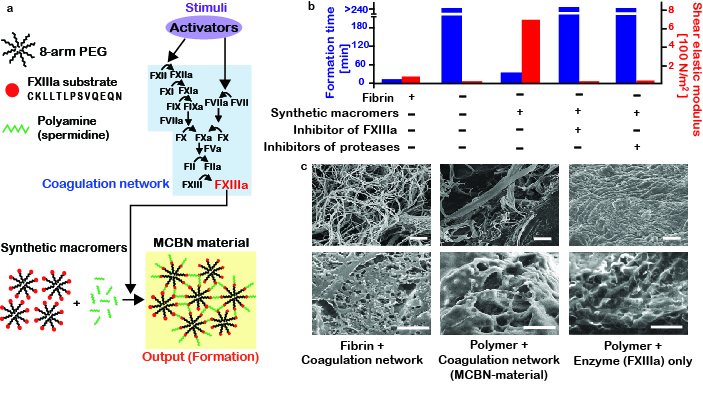
A Synthetic Blood Clot that Forms in Response to Numerous Specific Stimuli
Christian Kastrup
Read More

